Published on October 19, 2026
Contact Dr. Raphael CV DownloadCan a functional capacity evaluation for social security disability help document the limits SSA considers, or does the agency make its decision another way? The distinction matters. An FCE can record physical abilities and limitations, but it is not the same as Social Security’s residual functional capacity (RFC) assessment. Claimants generally are not required to obtain one.
It is reasonable to want clear, objective evidence of what you can and cannot do. An FCE may describe those limits in work-related terms, such as lifting, standing, or reaching. But SSA makes its own RFC assessment from the complete record. It is not bound by an FCE, and test findings alone do not determine eligibility.
This article explains how SSA assesses RFC, what an FCE can and cannot establish, and how its findings may fit into a disability record. It also covers how specific, well-documented results can connect functional limits to work activities, and why they should be read alongside other relevant evidence. The central point is straightforward: an FCE documents function; SSA decides RFC.
A functional capacity evaluation for social security disability examines a person’s abilities and limitations in relation to physical work tasks. Depending on its scope, it may document performance on activities such as lifting or carrying. The findings can add functional detail to a disability record, but they are evidence, not an SSA eligibility decision.
A functional evaluation documents observed abilities and limitations; an RFC is SSA’s administrative assessment of work capacity based on the evidence in the claim file. An FCE reports what its evaluation examines. It does not make SSA’s decision or establish what work a person can perform in every setting.
An FCE report may describe the tasks assessed, the claimant’s performance, and any limitations or difficulties observed. Depending on its scope, it may address physical activities such as lifting, carrying, standing, walking, reaching, or using the hands. These are examples, not a standard checklist. Evaluations vary in purpose, scope, and methods, so a finding is meaningful only in context.
For example, if lifting is assessed, a report might describe the task and the performance observed. A clear report ties the finding to that specific activity rather than relying on a broad statement such as “limited.” It should also distinguish what was observed from what was not tested. Performance on a task at a particular time does not automatically establish a person’s capacity to repeat it throughout a workday or workweek.
The Functional Capacity Evaluation (FCE) overview offers general background on the purpose and types of these evaluations. For a disability record, the case-specific report describes the tasks actually assessed and the findings produced.
An FCE is not a medical diagnosis, a treatment plan, or a ruling on benefits. It focuses on functional performance within the evaluation’s scope. It does not independently establish the cause of a limitation, determine whether a person meets SSA’s disability rules, or decide whether benefits should be awarded.
SSA makes the disability determination under its own rules and considers the evidence in the claim. An FCE may contribute information about physical function, but one evaluation cannot establish eligibility by itself. Its findings should be considered alongside other relevant evidence, including medical records and information about the claimant’s limitations.
Keep the roles distinct: the evaluator documents findings; SSA decides the claim. A useful FCE report makes its scope and observations clear without presenting clinical findings as a conclusion about benefits or legal entitlement.
Residual functional capacity, or RFC, describes the most a person can still do despite limitations from an impairment. It translates evidence about health and function into work-related abilities and restrictions. The assessment may address physical demands such as lifting, standing, walking, or reaching, as well as other work-related limits supported by the record.
RFC is an SSA finding, not another name for an FCE. An FCE may document performance on assessed tasks. SSA determines RFC from relevant medical and other evidence in the claim. The evaluation can inform that decision, but it does not set the RFC or control how SSA weighs the record.
SSA considers evidence relevant to the claimant’s condition and ability to function. This can include medical records, examination findings, treatment history and effects, and evidence about symptoms. Statements from medical sources may be considered alongside descriptions from the claimant and people familiar with the claimant’s daily activities.
The significance of a particular item depends on how it fits with the record as a whole. A test result may offer useful detail, but it does not automatically outweigh other evidence. A reported limitation is also easier to interpret when its context and consistency with the broader record are clear. The aim is to understand functional capacity from the evidence together, not to treat one document as the entire case.
An FCE can provide task-level details that help describe how a limitation may affect work. For example, if an evaluation assesses lifting, its findings may document observed performance on that task. Those details can be compared with evidence about the demands of the claimant’s past work and, where relevant, other work considered in the disability analysis.
That connection should be specific. A finding about lifting describes a tested activity; it does not by itself establish how long a person can sustain work, whether the same limitation applies to every job, or what SSA’s final RFC should be. The report’s scope matters, as does its consistency with medical records, symptom evidence, and other functional information.
For claimants considering a functional capacity evaluation for social security disability, the practical question is what functional information the evaluation can add to the record. Clear documentation may help explain a limitation in work-related terms. SSA still weighs the findings with the complete case record and makes its own determination.
Injury Consulting LLC provides Functional Capacity Evaluation services with case-specific findings that can help clarify physical abilities and limitations. The purpose is documentation, not a prediction or guarantee of an SSA decision.
These terms describe different parts of a disability claim. An FCE is an evaluation. A consultative examination is an examination SSA may arrange when it needs additional information. Treating-source evidence comes from a medical source. RFC is SSA’s assessment of work-related capacity based on the claim record. None of these labels, by itself, determines the outcome.
| Evidence type | Purpose | Author | Scope and role in the claim record |
|---|---|---|---|
| Functional Capacity Evaluation | Document physical function for assessed tasks | Evaluator conducting the FCE | May describe observed performance and limitations within the evaluation’s scope. SSA may consider the findings with other evidence. |
| Residual Functional Capacity | Assess the most a person can still do despite limitations | SSA | Administrative finding based on relevant medical and other evidence. It informs the agency’s work-related analysis. |
| Consultative examination | Provide additional examination information when SSA determines it is needed | Examiner arranged by SSA | Scope depends on the examination requested and the issues in the case. Its findings become part of the record SSA reviews. |
| Treating-source evidence | Describe medical findings, care, and limitations documented by a medical source | Medical source | May include records, examination findings, and statements relevant to function. SSA considers it alongside the rest of the evidence. |
An FCE records findings from an evaluation; an RFC is SSA’s administrative finding. For example, an FCE may report performance on a lifting task if that task was assessed. That detail may help describe a work-related limitation, but it does not replace the agency’s broader review or establish whether the claimant meets SSA’s disability standard. The terms are not interchangeable, even when both discuss physical capacity.
SSA may arrange a consultative examination when additional examination evidence is needed to evaluate a claim. It is not another name for an FCE. Its purpose and scope depend on what information SSA needs and the examination arranged. An FCE, by contrast, is a functional evaluation whose findings depend on the tasks and methods used. Current SSA guidance should be consulted for procedural details about a specific examination.
For a functional capacity evaluation for social security disability, interpret the report by asking what it actually assessed and documented. A finding about one task should not be stretched to cover untested activities. Compare it with relevant records, source statements, and other evidence. The goal is a clear picture of how the evidence relates to work, not a contest in which one evidence type automatically outranks another.
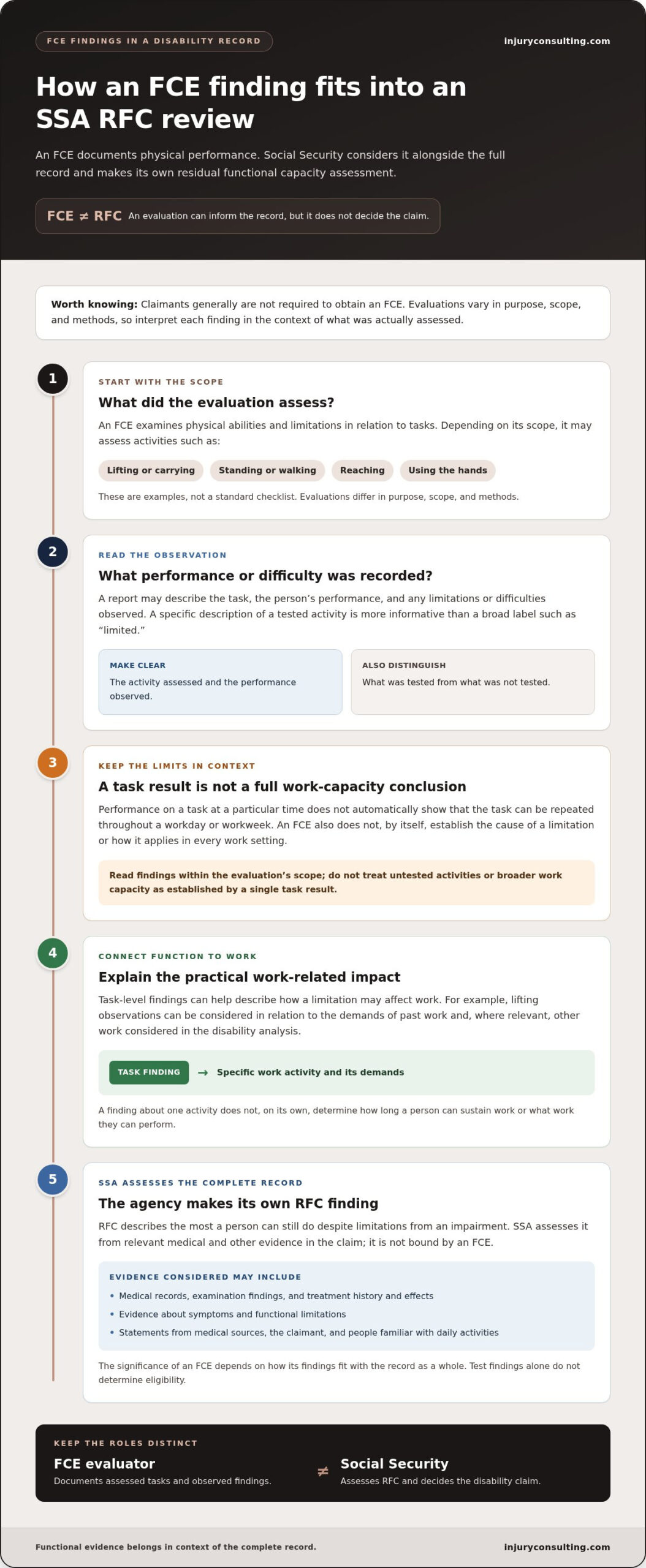
Functional evidence is easier to interpret when it shows a clear path from limitation to finding to work-related effect. A report that says “difficulty standing” gives little context by itself. A stronger account identifies what was assessed, what happened during the task, and how the observed limitation could affect a relevant work activity. This structure clarifies the evidence without predicting SSA’s conclusion.
Use concrete language. If standing was assessed, describe the documented performance and any reported or observed limitation. Then explain how that finding may relate to work requiring standing. Apply the same approach to sitting, walking, lifting, or other assessed functions. Avoid broad conclusions such as “cannot work” unless that conclusion is supported by the appropriate decision-maker. Instead, state the functional finding and its possible relevance to work activity.
Sustained work can involve performing tasks over time, not just completing one activity during an evaluation. If the report does not assess duration or repetition, do not assume it establishes those capacities. Use other relevant records for context, and distinguish the evaluator’s observations from information reported by the claimant or documented elsewhere.
Interpret findings in context. Relevant details may include the evaluation date, tasks and methods used, conditions during testing, symptoms reported, and any changes in performance recorded in the report. If an FCE finding differs from another record or a description of daily activity, identify the difference neutrally. A difference may need context; it is not, by itself, proof that either account is inaccurate.
For a functional capacity evaluation for social security disability, consistency across the report, medical records, and reported limitations helps readers understand what the evidence supports and where its boundaries lie.
Checklist: separate findings from interpretation.
Injury Consulting provides case-specific Functional Capacity Evaluations to document function within the evaluation’s scope.
A case-specific FCE may be useful when the record describes a physical condition but gives limited detail about how it affects particular activities. The relevant question is not simply whether an evaluation can be added. It is whether clearer task-level findings could help explain a functional issue that matters to the case.
For example, records may document a lifting restriction without describing performance on a relevant task. Or the file may contain differing accounts of a person’s ability to stand or walk. An FCE may provide additional observations about functions it assesses. It cannot resolve every difference in the record, and its findings should not be treated as a substitute for other evidence.
A focused evaluation can organize findings around the functional questions at issue. The report may clarify which activities were assessed, what performance was observed, and what limitations the findings support. That specificity helps readers understand the evidence without turning a test result into a broader conclusion the evaluation did not establish.
Useful documentation stays within its limits. It distinguishes observed performance from reported symptoms, identifies the scope of the evaluation, and avoids conclusions about untested activities or benefit eligibility. The value is clarity, not a promised outcome. An FCE is one potential source of functional evidence within the broader disability record.
Before arranging an evaluation, identify the functional question it is meant to address and how the resulting findings could fit with existing records. A case-specific FCE is most relevant when its scope responds to a genuine need for clearer functional information. It should add detail rather than repeat what the file already establishes.
Injury Consulting provides Functional Capacity Evaluations. Dr. Raphael Sadiwa’s work draws on 30 plus years of clinical experience and peer-reviewed data. These foundations support careful functional documentation, but do not guarantee that SSA will adopt a report or reach a particular decision.
When additional task-level evidence may clarify a disability record, a case-specific Functional Capacity Evaluation from Injury Consulting can document the functions relevant to the case. Consider its purpose in relation to the evidence already available and the specific functions that need clearer documentation.
The distinction remains essential: an FCE can document functional findings within its scope. SSA reviews the complete record and makes the benefit determination under its own rules.
Before adding a functional capacity evaluation for social security disability, identify the specific question the current record leaves unanswered. Is a physical limitation documented but its effect on a work task unclear? Would further functional findings add useful detail, or repeat evidence already in the file? A focused decision can help keep the record relevant and grounded.
An FCE is one potential source of functional evidence, not a substitute for SSA’s review or a promise of benefits. Its value lies in clear findings that address the case’s functional questions and can be considered alongside the broader record.
Injury Consulting provides Functional Capacity Evaluation services. To discuss a case-specific evaluation, contact Injury Consulting.
Careful documentation can make functional limitations easier to understand. Keep the focus on what the evidence shows and on the specific questions the record needs to answer.
No. An FCE is not automatically required for an SSDI or SSI claim. SSA reviews the evidence in the file and may arrange a consultative examination if it needs more information. That is different from a claimant arranging an FCE to add functional detail. Requirements and procedures can change, so check current SSA guidance for the rules that apply to your claim rather than assuming an FCE is a required step.
It may help by documenting physical performance relevant to a disputed or unclear work activity. For example, findings about repeated reaching could add detail if the claim record discusses difficulty using the arms but offers limited task-specific information. A functional capacity evaluation for social security disability remains one piece of evidence. Its usefulness depends on its scope, clarity, and relationship to the rest of the file. It cannot promise eligibility or approval.
SSA may consider an FCE as evidence, but that does not mean it automatically accepts every conclusion or assigns the report a predetermined weight. The findings are evaluated in the context of relevant medical and other evidence. A report that clearly identifies what was assessed and what the findings support gives the agency information to consider. Current SSA regulations and policy govern how evidence is evaluated, so do not assume a particular FCE will control the decision.
No. An FCE is an evaluator’s documentation of function within the activities and methods used. An RFC is SSA’s administrative finding about work-related capacity based on the evidence in the claim. An FCE may contribute observations, such as documented difficulty performing an assessed task, but it does not set the RFC. The distinction is useful when reviewing a report: separate its findings from the agency’s later assessment of the full record.
SSA may arrange a consultative examination when it needs additional evidence to decide a claim. That examination is not the same thing as an FCE. The need for an examination and its scope depend on the case and current SSA procedures. Do not assume that a scheduled consultative examination will include a full functional evaluation, or that SSA will arrange a separate FCE. Follow the instructions in any notice from SSA and review current guidance.
There is no single report format that applies to every evaluation. Useful details may include the evaluation date, activities assessed, methods and relevant testing conditions, observed performance, and limitations supported by the findings. The report should distinguish observed results from reported symptoms or broader interpretations. For example, if a task was not assessed, the report should not imply that it was. Clear links between documented function and relevant work activities aid interpretation.
No. An FCE can document functional findings, but it does not by itself establish eligibility for SSDI or SSI. SSA applies its disability rules and reviews the complete record, which may include medical evidence and information about symptoms and daily function. A report may support a specific limitation, but it cannot establish every issue relevant to the claim or guarantee an outcome. Consider its findings alongside the other evidence, not as a substitute for it.
Contact Dr. Raphael CV DownloadDr. Raphael reviews your case, documents every future cost your client will face. Explained in a way that juries understands. Dr. Raphael delivers a report built to survive cross-examination. Available nationwide. Call, text, or email to discuss your case.


