Published on October 20, 2026
Contact Dr. Raphael CV DownloadA strong résumé doesn’t make an expert the right fit for a disputed life care plan. When choosing a life care planning expert, start with whether the expert’s clinical perspective matches the issues in your case and whether the reasoning behind each opinion can withstand scrutiny. Credentials matter, but they don’t show how an expert evaluates records, supports future-care recommendations, or explains conclusions under cross-examination.
You need a practical way to assess case-specific clinical fit, reasoning, and supporting documentation before relying on an opinion. This guide explains how to connect disputed questions to relevant experience, examine the basis for projected care needs, and define the scope of an engagement. Injury Consulting’s life care planning work draws on peer-reviewed data and Dr. Raphael Sadiwa’s 30 years of clinical experience. Reports are designed for legal scrutiny.
For attorneys selecting an expert, the practical question is whose experience and analysis can address the disputed future-care issues in the case. Choosing a life care planning expert should start with those issues, not with the longest résumé or broadest list of credentials.
A life care planning expert evaluates anticipated future healthcare and support needs and develops a reasoned plan from the available information. The work may address projected services, equipment, and other care needs. Which issues require analysis depends on the record and the dispute. Injury, case posture, and intended use all affect the fit. Counsel may need an initial plan, a review of an existing plan, rebuttal analysis, or testimony. These assignments are related, but they do not call for identical work.
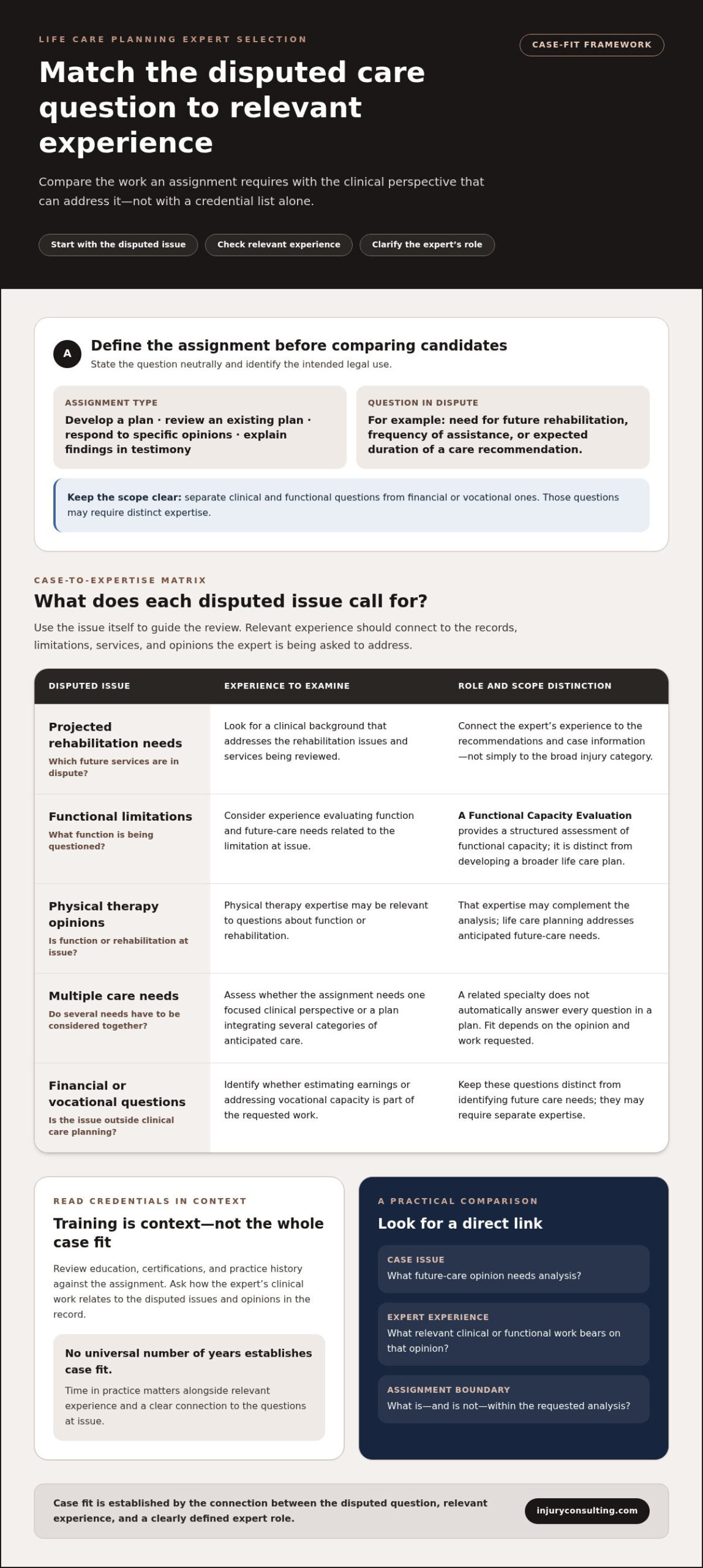
First, state the question the expert must answer. Is the assignment to develop a plan, examine another planner’s assumptions, respond to specific opinions, or explain findings in testimony? Describe the task without building in a preferred conclusion. For example, specify whether the dispute concerns the need for future rehabilitation services, the frequency of assistance, or the expected duration of a care recommendation.
Separate clinical and functional questions from financial or vocational ones. A life care plan may identify future care needs, while estimating earnings or addressing vocational capacity may require distinct expertise. Clear boundaries help counsel set an appropriate scope and avoid treating one expert’s opinion as an answer to every issue.
Credentials can establish relevant training, but they don’t show whether an expert has addressed the clinical questions raised by a particular injury. Look for experience connected to the disputed needs, the records under review, and the opinions the expert will be asked to explain. Broad experience can be valuable, but it may not answer a narrow, case-specific question.
Consider a case disputing whether a particular functional limitation supports ongoing assistance. A long healthcare résumé may show breadth, while direct experience evaluating function and future-care needs related to the issue may be more informative. One background does not automatically qualify or disqualify a candidate. The key is whether the experience bears on the question counsel needs answered.
Before comparing candidates, write down:
This case-first definition gives counsel a consistent basis for evaluating expertise. It also makes gaps visible before a broad credential list is mistaken for a direct fit.
Once the assignment is defined, connect each disputed issue to experience that can help analyze it. Choosing a life care planning expert is not a search for the most impressive collection of credentials. It is an assessment of whether the expert’s clinical perspective fits the injury, functional limitations, and anticipated care at issue.
A case-to-expertise matrix makes that assessment concrete. List each issue and the background or work experience relevant to it. This helps show whether the proposed expert can address the central questions directly or whether the analysis calls for a complementary perspective.
Match the clinical focus to the question, not just the general injury category. Ask how the expert’s experience relates to the reported limitations, proposed services, and care recommendations under review. Some assignments call for a focused perspective on a particular function. Others require a broader view of how several needs fit into a future-care plan. Relevant experience helps explain why a recommendation follows from the case information.
These distinctions help prevent role confusion. A related specialty can complement life care planning, but it does not automatically answer every question in a plan. The fit depends on the opinion counsel needs and the work the expert is being asked to perform.
Review education, certifications, and practice history in light of the assignment. Consider what a credential represents, how the expert’s clinical work relates to the disputed issues, and whether that experience is pertinent to the questions in the record. No universal number of years establishes case fit. Time in practice matters alongside relevant experience and a clear connection to the opinions at issue.
Professional organizations and continuing education can offer useful context for evaluating an expert’s engagement with the field. The Professional Standards in Nurse Life Care Planning resource from the American Association of Nurse Life Care Planners provides a reference point for understanding professional standards in nurse life care planning. Use it as context, not as a substitute for case-specific evaluation.
Dr. Raphael Sadiwa brings 30 years of clinical experience, and his work draws on peer-reviewed data. The practical question is how that experience and supporting information apply to the disputed care issues in a particular matter. Attorneys assessing a potential life care planning expert can use the same case-centered approach: identify relevant experience, then examine its connection to the work requested.
Credentials indicate training and professional background. They don’t show how an expert reached a particular future-care opinion. When choosing a life care planning expert, assess the reasoning that connects case information to recommendations. The goal is to determine whether the analysis is transparent, supported, and clear enough to examine under challenge.
A defensible opinion is a reasoned conclusion supported by identified information that explains its assumptions and acknowledges relevant limitations. This describes the quality of the analytical process, not a guaranteed litigation result. No report or credential can promise admissibility, favorable testimony, or a particular outcome.
Follow the path from records and other relevant information to the expert’s conclusions. A useful analysis makes that path visible. It identifies the information supporting a recommendation, explains how it was interpreted, and distinguishes documented facts from assumptions. If a key record is missing or information is inconsistent, the report should make that gap clear rather than leave counsel to infer how it was handled.
Consider a recommendation for ongoing assistance. The analysis should explain how the information reviewed supports the identified need and any projected frequency or duration. A conclusion without that connection is harder to evaluate than one that shows its basis. Look for the reasoning, not just the list of services.
Evaluate whether the expert can explain the analysis in direct, understandable language. Counsel should be able to identify the basis for an opinion, the assumptions it depends on, and the limits of what it addresses. Jargon or unexplained leaps can make the reasoning harder to assess.
Consider how the analysis handles alternative interpretations. A clear opinion need not ignore information that may cut the other way. It should address relevant contrary information and explain why the expert reached the stated conclusion. That discipline makes the work easier to scrutinize and gives counsel a precise basis for weighing its strengths and limits.
This section focuses on candidate selection, not a complete review of life care planning methodology or legal admissibility standards. Examine whether the expert’s work shows a coherent, documented path from information to opinion, and whether the expert can explain that path under questioning. Injury Consulting’s reports are designed to be defensible in court and withstand cross-examination. That design supports scrutiny but does not guarantee a litigation result.
A scorecard makes candidate review more consistent and distinguishes documented strengths from favorable impressions. Before assessing candidates, separate essential requirements from secondary preferences. Essential requirements connect directly to the assignment, such as a relevant clinical perspective or the ability to explain the opinions at issue. Preferences may help distinguish otherwise suitable candidates, but should not make up for a gap in a core requirement.
Use one row for each criterion and one column for each candidate. Record the basis for every assessment, such as a specific example from a report, work history, or discussion of the assignment. Mark unresolved questions rather than filling gaps with assumptions. Weight criteria according to the case: a short rebuttal review and a plan expected to be explained at trial may place different demands on the expert.
| Criterion | Candidate A | Candidate B | Evidence to record |
|---|---|---|---|
| Case fit | Relevant, partial, or unresolved | Relevant, partial, or unresolved | Connection between the disputed issue and the expert’s perspective |
| Relevant experience | Examples and gaps | Examples and gaps | Related clinical, functional, or planning work |
| Reasoning | Clear, partial, or unresolved | Clear, partial, or unresolved | How information supports opinions; assumptions and limitations identified |
| Communication | Clear, partial, or unresolved | Clear, partial, or unresolved | Ability to explain the analysis in direct, understandable terms |
| Scope | Aligned, unclear, or unresolved | Aligned, unclear, or unresolved | Fit with the requested review, report, rebuttal, or testimony |
Apply the same criteria and evidence prompts to every candidate. Add a brief note beside each rating to explain its basis. “Relevant experience” alone is too general; record which experience bears on the disputed care issue. This approach helps keep résumé length or a polished interview from outweighing case-specific evidence.
Match communication needs to the assignment. An expert reviewing a plan may need to explain differences in analysis, while testimony may require clear answers under questioning. Assess whether the candidate can describe clinical reasoning without unexplained jargon and whether the work’s scope fits its intended legal use. Treat any mismatch as a question to resolve, not an automatic failing.
For attorneys choosing a life care planning expert, the scorecard should support judgment, not replace it. Prioritize essential case requirements, then weigh secondary preferences against the documented evidence. Injury Consulting’s life care planning work draws on peer-reviewed data and Dr. Raphael Sadiwa’s 30 years of clinical experience. Learn about case-specific life care planning engagements with Injury Consulting.
A defined engagement gives the expert a focused question to address and gives counsel a clear basis for reviewing the work. After choosing a life care planning expert, set out the disputed future-care issues, intended legal use, and deliverables. Avoid framing the assignment around a preferred conclusion. The expert’s role is to analyze the information and provide opinions within the agreed scope.
Use a practical sequence:
Summarize the case questions neutrally. Identify the disputed recommendations, the information relevant to them, and known gaps that may affect the analysis. Organize materials so the expert can understand what has been provided and what remains unresolved. A focused record set supports a clearer review without predetermining the conclusions.
Scope should distinguish the requested work from adjacent questions. Counsel may need a life care plan addressing anticipated future needs, a rebuttal to an existing plan, or expert witness support concerning a defined opinion. State the issues to be addressed and the expected form of the work. If the assignment has several components, specify how each relates to the case question.
Select the engagement based on the work required, not the service label alone. For a rebuttal, identify the opinions under review and the specific questions for analysis. For a planning assignment, describe the future-care issues to be evaluated. Clear deliverables help keep the work aligned with its intended use.
Injury Consulting provides life care planning and life care planning rebuttal services nationwide through Dr. Raphael Sadiwa. His work draws on peer-reviewed data and 30 years of clinical experience. Consider these factors in relation to the case-specific assignment, materials, and disputed opinions.
Before proceeding, confirm that the engagement description identifies the question, materials, scope, and deliverables in terms counsel can evaluate. This creates a defined starting point for the expert’s analysis without implying a particular result. Attorneys can review case-specific life care planning services from Injury Consulting.
Turn your evaluation into a precise account of what the case requires. Before opening a conversation, write a short issue statement that identifies the future-care opinion at stake, the question you need addressed, and how the analysis may be used. This gives the discussion a practical starting point without dictating the expert’s conclusions.
Choosing a life care planning expert is ultimately a case-specific judgment. Focus on whether the assignment, clinical perspective, and expected work align. If a question remains unresolved, state it clearly. A focused discussion can help define whether the matter calls for life care planning, rebuttal, or related expert support, and which materials will inform the work.
Injury Consulting works with attorneys on injury and disability cases nationwide. A clearly framed discussion keeps attention on the evidence and the work the case calls for. Discuss your case with Injury Consulting.
No. A treating physician provides care and addresses clinical questions connected to the patient’s treatment. A life care planning expert evaluates projected needs within a defined assignment, which may involve reviewing records and other case information. The expert’s clinical background does not make that person the injured individual’s treating provider. Keep treatment opinions distinct from future-care planning opinions when defining what the expert should address.
Yes. Some life care planning engagements include testimony, while others involve case review or reporting only. If testimony may be needed, define that expectation early and consider whether the expert can clearly explain the basis and limits of the opinions under questioning. Whether testimony is admitted depends on the case and applicable rules. Experience or preparation cannot guarantee admissibility or a particular result.
Not necessarily. Whether an examination is appropriate depends on the assignment, the questions being addressed, the available information, and the expert’s approach. Counsel reviewing an existing plan, for example, may be asking about the reasoning and support in that work. Another assignment may raise questions that require additional evaluation. Clarify what information will support the opinions and how any limits will be addressed.
Provide records that bear on the specific questions, such as relevant treatment documentation, information about functional limitations, and materials describing the future-care recommendations in dispute. Include an index identifying what has been supplied, the date range covered, and any known gaps. If a key period of care is undocumented, flag it rather than implying the record is complete. The needed materials vary by assignment.
Yes. Injury Consulting serves attorneys handling injury and disability cases nationwide. Nationwide service does not make legal or evidentiary requirements uniform. Identify the relevant jurisdiction and intended use of the work when defining the engagement, then assess applicable case requirements through counsel. Procedures or standards from one matter do not automatically apply to another.
Engage an expert when the case raises a defined future-care question requiring life care planning, review, or rebuttal. Timing depends on the procedural schedule and the maturity of the record. Early involvement can help counsel frame the assignment and identify information needs; a later engagement may focus on developed opinions or records. Choose an expert whose work aligns with the assignment and case calendar.
Contact Dr. Raphael CV DownloadDr. Raphael reviews your case, documents every future cost your client will face. Explained in a way that juries understands. Dr. Raphael delivers a report built to survive cross-examination. Available nationwide. Call, text, or email to discuss your case.


