Published on November 3, 2026
Contact Dr. Raphael CV DownloadA future-care estimate is only as strong as the evidence behind it. Peer-reviewed data for a life care plan helps test whether care recommendations are clinically supported, while geographically relevant, verifiable cost estimates ground projected expenses. Together, these evidence sources support plan updates and a clear analysis of future costs in present-value terms.
That evidence matters because a recommendation must do more than sound reasonable. It needs a documented basis that can be explained and examined. This article shows how peer-reviewed research informs care recommendations, how local cost data strengthens estimates, and how these elements contribute to litigation analysis.
You’ll also learn why a plan may need review as a person’s needs or available evidence change, and how present-value analysis frames future costs. The practical focus is on connecting clinical support, cost methodology, and transparent reasoning so the conclusions can be understood and scrutinized.
A defensible cost estimate connects each future-care recommendation to evidence and pricing relevant to the person’s location. In the United States, life care plan peer reviewed data can inform recommendations, while geographically relevant cost evidence grounds projected expenses.
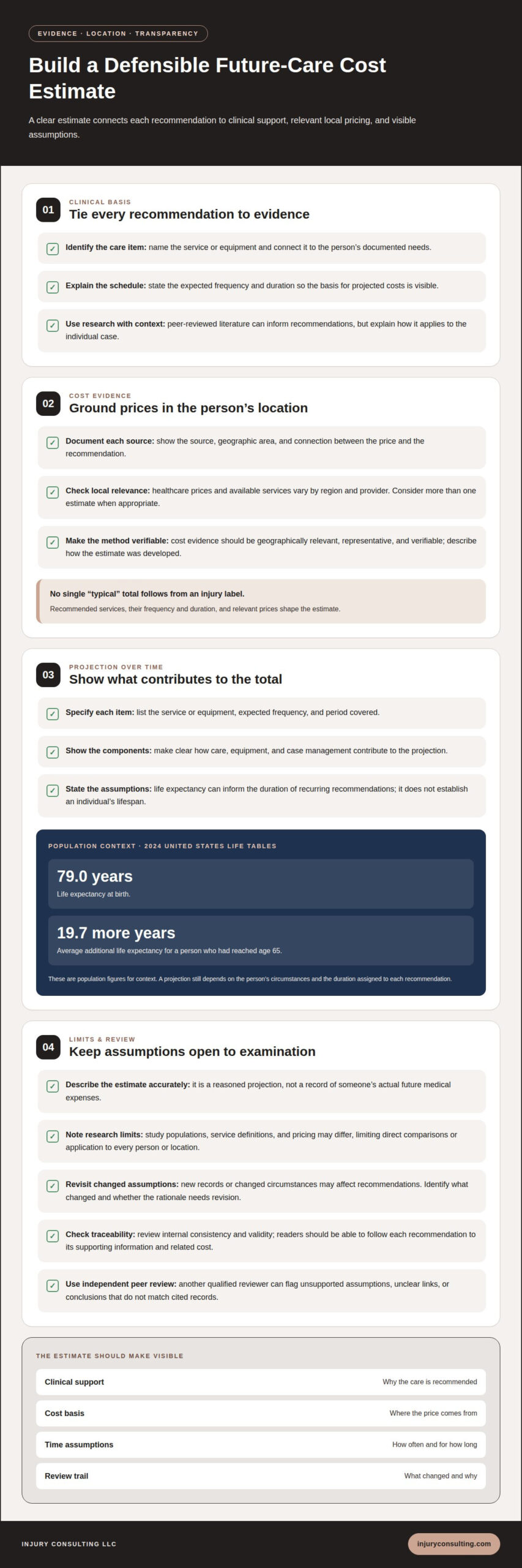
Verifiable cost data identifies the basis for each projected item, including its source, location, and relationship to a care recommendation. The International Academy of Life Care Planners’ standards call for costs to be geographically relevant, representative, and verifiable. Research and cost analysis can take substantial work. Documenting the method allows readers to assess how an estimate was developed.
United States life care planners should also understand applicable training and practice standards. The International Academy of Life Care Planners’ Standards of Practice is in its 4th edition, published in 2022. ICHCC certification candidates must complete a 120-hour life care planning training program or training in an applicable area.
Location matters because healthcare prices and available services vary by region and provider. The analysis should identify the geographic basis for an estimate and consider more than one estimate when appropriate. An injury label alone does not establish a typical plan cost. Recommended services, their frequency and duration, and relevant prices shape the total. Clear cost delineation shows how each item relates to the person’s needs.
Future-care projections translate supported recommendations into anticipated expenses over time. Each item should identify the service or equipment needed, its expected frequency, and the period covered. This helps readers see how care, equipment, and case management contribute to the projection. It also makes assumptions visible rather than burying them in a single total.
Life expectancy informs how long recurring recommendations may continue, but it does not establish an individual’s lifespan. The 2024 United States life tables report life expectancy at birth of 79.0 years. A person who had reached age 65 could expect an average of 19.7 more years. These population figures provide context; a projection still depends on the person’s circumstances and the duration assigned to each recommendation.
A life care plan estimate is a reasoned projection, not a record of someone’s actual future medical expenses. Actual spending depends on the services used, provider prices, location, and changing care needs. There is no single typical total for common injuries and disabilities: recommendations and their documented duration and frequency drive the estimate.
Published research can inform care planning, but its assumptions may not fit every person or location. Differences in study populations, service definitions, and pricing can limit direct comparisons. Reviewers should examine how evidence supports each recommendation and whether cost sources represent the relevant area. Life care plan peer reviewed data is most useful when its limitations and connection to the individual case are clear.
A life care plan report brings clinical records, interviews, and cost analysis together in documented findings. Its conclusions should remain traceable as the injury-related evaluation develops.
Re-evaluation means reviewing recommendations when new records or changed circumstances affect the plan’s assumptions. Life care planning data collection is cyclical, not strictly linear. A planner may return to an earlier phase to obtain records or clarify information from the evaluee, family, or treatment team. This helps keep findings aligned with the evidence considered.
A practical review compares the existing plan with later evidence. For example, new treatment records may clarify whether a recommendation still reflects the person’s documented needs. The reviewer can identify what changed, what supporting information is new, and whether a recommendation or its rationale needs revision. This creates a clear record of how the evaluation developed instead of silently carrying forward outdated assumptions.
Reports should present a detailed plan that includes costs, then undergo checks for internal consistency and validity before findings are shared with relevant parties. Readers should be able to trace each recommendation to its supporting information and related cost. If a later record changes one part of the analysis, the reviewer can track its effect through the report rather than treating the total as unexplained.
Peer review is an independent examination of a plan’s reasoning, evidence, and internal consistency by another qualified reviewer. A second reader can identify unsupported assumptions, unclear links, or conclusions that do not match the cited records. Sample plans can illustrate report organization, but they cannot establish another person’s needs or replace a case-specific evaluation.
A useful review tests the logic, not just the document’s appearance. The reviewer can compare recommendations with the cited records, check whether the report explains its assumptions, and flag inconsistencies for clarification. Peer-reviewed literature can inform a recommendation, but the report should explain how that evidence relates to the individual case. This makes the reasoning easier to examine in litigation.
Access control is also part of reliable reporting. Medical records and life care plans may contain sensitive personal information, so teams should limit access to people involved in the evaluation and use secure storage. Passwords should be managed so authorized readers can access the current report and distinguish it from outdated drafts. Before an evaluation or access to medical records, planners must comply with HIPAA regulations and obtain informed consent.
When a Functional Capacity Evaluation is relevant, its findings can contribute functional evidence to an evaluation. Explore Functional Capacity Evaluation services as a related resource for documenting functional capacity.
A life care plan is a dynamic document outlining present and future needs, along with associated costs, for someone with catastrophic injuries or ongoing health care needs. The definition cited in life care planning dates to 1998. Its purpose is practical: connect a person’s documented circumstances with recommendations that can be understood, evaluated, and revised.
A life care plan brings different types of information into one structured resource. Medical records describe health care history and ongoing needs. Evaluations can address physical ability and functional limitations. Recommendations then explain which services, equipment, or support relate to those findings. For a person with a chronic condition, the plan can distinguish ongoing needs from care associated with a particular injury.
This structure matters because records do not automatically explain what future support may involve. A treatment note, for example, may document a limitation without explaining how it affects daily activities. A life care plan connects the finding to a recommended resource and explains the reasoning, giving readers a way to assess whether the recommendation follows from the evidence.
Life care plans differ from advance care directives. An advance care directive is a formal health-planning document subject to local rules. A life care plan is broader and can serve as a record of present and future needs for a family. It may point readers to the location of a directive, identify important contacts, and note helpful routines or what matters to the person at home. It does not replace the formal document.
Insurance information may help clarify which resources are being considered, but the plan’s central task is to describe needs and associated costs. Its reasoning should be clear: what the records show, how the person’s abilities are affected, and why a recommendation follows. This sequence helps attorneys, evaluators, and families distinguish evidence-based planning from an unsupported list of possible services.
A life care plan is dynamic because needs and supporting information can change. If new records alter the understanding of a person’s health care requirements, the plan may need review. Recommendations can then be assessed against updated evidence rather than treated as permanent. Not every change requires a new plan; the key question is whether the new information affects its conclusions.
In litigation, this definition helps set the scope of the analysis. A life care plan does not merely forecast expenses or summarize diagnoses. It organizes evidence about future needs and shows how recommendations relate to the person’s circumstances. Readers can examine the records, reasoning, and projected support as connected parts of one document.
In litigation, a life care plan connects future-care recommendations with a projected schedule of needs and costs. Present-value analysis expresses those future costs as an equivalent value today. Keeping the care assumptions and financial calculation distinct helps readers examine each part of the analysis.
A projected expense may occur once, recur, or arise at a later stage. Timing matters because a cost expected now differs from the same cost projected years ahead. A clear schedule identifies when each recommendation is expected, how often it recurs, and the period covered. This lets reviewers trace the calculation instead of relying on an unexplained total.
A useful litigation report makes its calculation reproducible. It identifies the future-care items included, the period assigned to each, and the financial assumptions used to convert future costs. For annual expenses, the report should distinguish recurring costs from one-time expenses. That distinction helps prevent a yearly item from being treated like a single purchase.
Present-value analysis does not determine whether a treatment recommendation is clinically supported. It addresses how projected future costs are expressed today. Keeping those questions separate helps the fact finder assess the care evidence and financial method on their own terms. The result is a clearer record of what the plan recommends, when costs may arise, and how the present figure was calculated.
A future-care recommendation needs a clinical rationale tied to documented needs. Medical necessity isn’t established simply by placing a service on a list. The reasoning should show how the person’s injury, current function, and health care evidence support the proposed care. This helps readers assess whether a recommendation addresses a relevant need or relies on an assumption.
Life care planners estimate future medical and support needs by reviewing records, interviewing the evaluee, family members, and treatment team, and observing the evaluee’s activities. They may revisit earlier evidence-gathering stages as new questions arise. Life care plan peer reviewed data can inform the expected duration and frequency of future care, while case-specific findings connect that research to the person’s circumstances.
Each recommendation should identify the need, proposed service, and supporting evidence. For example, a rehabilitation recommendation should relate to documented functional limitations, not just a diagnosis. The explanation should distinguish physical needs from mental or social support needs when those issues appear in the evidence. Clear documentation lets a reviewer trace the rationale without treating every possible service as necessary.
Consider a home-care schedule. If a person wakes slowly, an example plan recommends scheduling appointments after 10 am. That timing links a practical recommendation to an observed routine. In another example, confusion may prompt attention to hydration, hearing aids, and possible infection symptoms. These details show how observations can shape recommendations instead of relying on generic assumptions about care.
Peer-reviewed research supports recommendations when its findings address the relevant intervention and help explain expected frequency or duration. It doesn’t replace individual evidence. A study may describe a broader group, so a life care plan must explain why its findings apply to the person being evaluated. Life care plan peer reviewed data is most useful when the report distinguishes research findings from case-specific observations and records.
Recommendations also need clear boundaries. The report should state what service is proposed and which documented need it addresses. For instance, a recommendation for ongoing assistance should explain the functional issue supporting it. If the evidence supports a narrower service or shorter duration, the analysis should reflect that. This precision makes the plan easier to evaluate.
Examine whether each recommendation has a clinical basis, an identifiable record or observation, and a clear link to the person’s function. For a case requiring independent analysis of physical function, request a Functional Capacity Evaluation to document relevant functional findings.
Injury Consulting LLC provides Life Care Planning for cases requiring documented future-care recommendations grounded in evidence. Turn to this work when a claim needs a plan that connects clinical findings, peer-reviewed data, and projected care needs. Dr. Raphael Sadiwa’s work draws on peer-reviewed data and 30 years of clinical experience, with reports designed to be defensible in court and withstand cross-examination.
When a plan’s reasoning or recommendations need examination, Injury Consulting LLC provides Life Care Planning Rebuttal. Physical Therapy Expert Witness services and Functional Capacity Evaluation (FCE) can also address cases involving physical function and related evidence.
To discuss how these services relate to your case, visit Injury Consulting LLC online.
The next step is to identify the decision your life care plan must support. Is the central issue the scope of future support, the basis for a recommendation, or the reasoning behind a competing projection? A focused question keeps the analysis relevant and gives reviewers a clear point to examine.
Before relying on a plan in litigation, consider whether its reasoning can be traced from the underlying evidence to the conclusion. A life care plan grounded in peer-reviewed data should make that connection understandable to attorneys, opposing reviewers, and the fact finder. The aim isn’t to eliminate every disagreement. It is to clarify which assumptions drive the dispute and what evidence bears on them.
Injury Consulting offers Life Care Planning, Life Care Planning Rebuttal, and Physical Therapy Expert Witness services for cases that require this focused analysis. Discuss the needs of your case and the relevant questions with Injury Consulting. Contact Injury Consulting to take the next step with a clear, evidence-focused approach.
A life care plan organizes anticipated care needs and supporting recommendations for an individual case. Depending on the evidence, it may address medical services, rehabilitation, equipment, and support needs. For example, a plan for someone with mobility limitations might distinguish recommended therapy from assistive equipment. Its value lies in showing how each proposed item relates to the person’s documented circumstances, rather than presenting a generic checklist.
No single peer-reviewed study validates an entire life care plan or its total projected cost. Research can support specific clinical recommendations, including the rationale for a service’s duration or frequency. Cost projections require a separate review of verifiable, geographically relevant pricing evidence. For example, a clinical study may inform a therapy recommendation, while relevant pricing sources support the estimate for that service.
Courts assess the evidence and reasoning presented in each case; a plan’s label alone does not establish its reliability. Review may focus on whether the expert explains the methods used, connects recommendations to records, and addresses questions about assumptions. In testimony, a clear explanation of why a recommendation applies to the individual can help distinguish case-specific analysis from a generalized opinion.
Search academic research databases using the person’s condition, proposed service, and question, such as rehabilitation frequency or duration. Apply peer-reviewed filters where available, then review each study’s population, methods, and findings. Check whether its participants and intervention resemble the case being assessed. A relevant article can inform a recommendation, but its findings still need to be connected to the individual’s records and circumstances.
Contact Dr. Raphael CV DownloadDr. Raphael reviews your case, documents every future cost your client will face. Explained in a way that juries understands. Dr. Raphael delivers a report built to survive cross-examination. Available nationwide. Call, text, or email to discuss your case.


