Published on October 12, 2026
Contact Dr. Raphael CV DownloadA life care planner evaluates documented injury-related needs and organizes anticipated future care into a reasoned framework. The role involves more than listing treatments or assigning costs.
Treating clinicians provide care, and attorneys provide legal advocacy. A life care planner connects medical and functional information to projected services, equipment, and support. The resulting analysis is not treatment, a legal opinion, or a guarantee that every projected item will be accepted.
This article explains the planner’s role, boundaries, and process. At Injury Consulting LLC, Dr. Raphael Sadiwa brings 30 years of clinical experience and uses peer-reviewed data for case-specific analysis designed for courtroom scrutiny.
A life care planner bridges the gap between injury or disability information and a structured view of anticipated future care. The analysis considers records together to identify continuing or emerging needs and the clinical support for those projections.
A life care planner evaluates and organizes anticipated injury- or disability-related needs; a life care plan documents those needs and the reasoning behind them. The planner conducts the analysis; the plan is the resulting document. Neither replaces a treating clinician’s diagnosis or treatment.
In litigation, the analysis should connect each projected need to the individual’s documented circumstances rather than extend current services automatically or assume every intervention is necessary. It clarifies clinical and functional information while leaving disputed facts and legal conclusions to decision-makers.
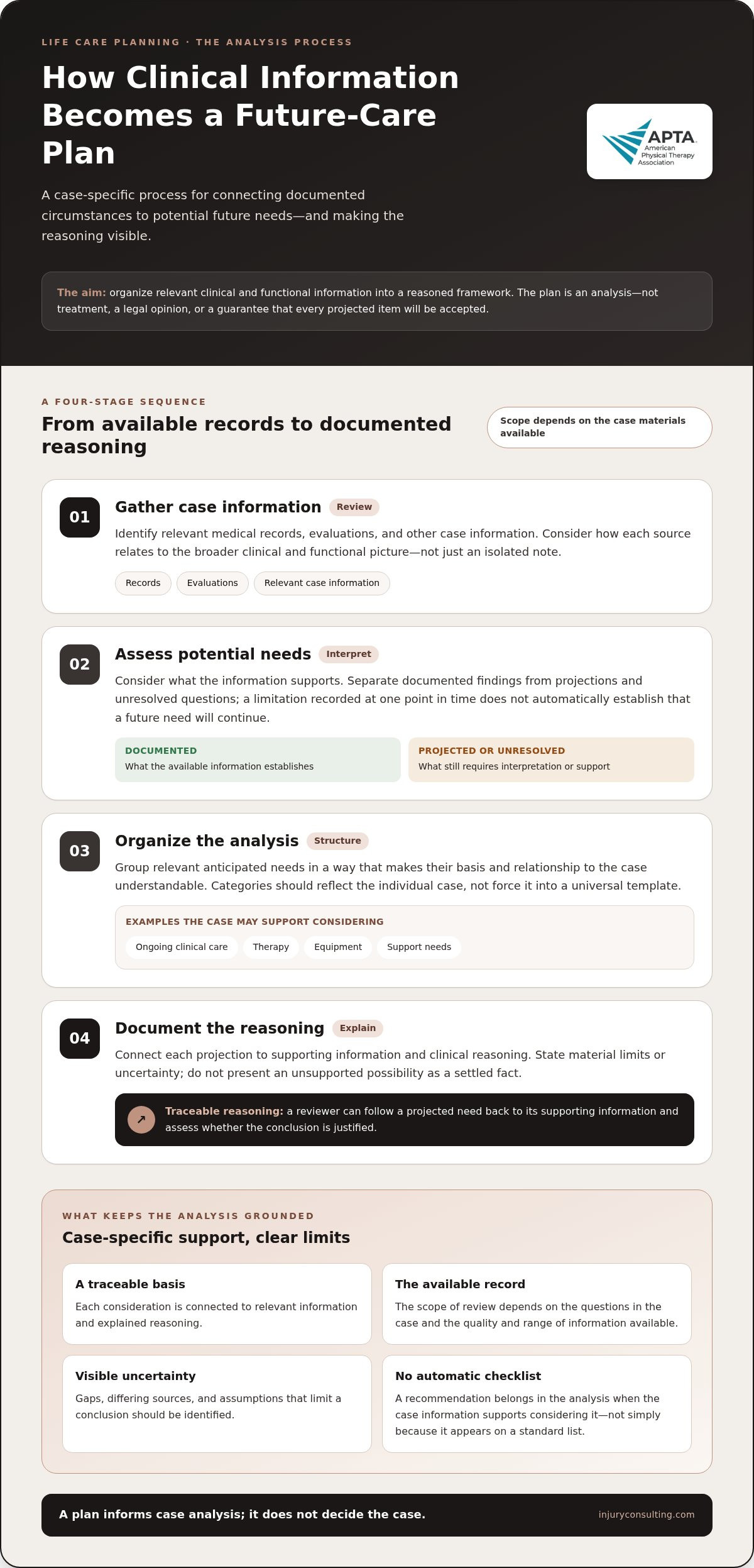
A planner reviews relevant records, evaluations, and case information to understand the injury, functional effects, and care received. Based on the case and available materials, the planner considers supported future services and needs, such as clinical care, therapy, or equipment.
Each conclusion should have a traceable basis. A documented functional limitation, for example, should be linked to any projected need. Possibility does not equal requirement; the planner explains evidence rather than presenting assumptions as facts.
A life care plan organizes anticipated care needs and related considerations into a forward-looking framework. Depending on the case, it identifies services or equipment and explains how the available information supports them.
In litigation, the framework helps participants examine the basis, scope, and assumptions of a future-care analysis. It does not establish liability, determine damages, or guarantee acceptance of a projected need.
A defensible plan makes its reasoning visible. It links an individual’s condition and function to potential future needs and distinguishes established information from interpretation. Its scope depends on the case questions and the quality and range of available information.
The planner may review medical records, evaluations, and other relevant information to understand the clinical context. Because records differ in focus and timing, the analysis considers how each source fits the broader picture.
A treatment note may document a limitation, while an evaluation explains its functional effect. Together, they may support analysis of a future need, but do not automatically prove it will continue. The planner should explain the support and identify gaps.
The planner assesses relevant needs, organizes findings into care or support categories, and documents the reasoning for each projection. Categories should reflect the case, and recommendations should be traceable to supporting information rather than copied from a standard list.
Traceable reasoning lets reviewers follow each projected need to its supporting information and assess whether it is justified. The analysis should disclose incomplete records, conflicting sources, assumptions, and any need for further support.
This structure helps attorneys examine the evidence, clinical support, and remaining uncertainty. Injury Consulting LLC develops life care planning analysis using peer-reviewed data and case-specific reasoning. Strength depends on the connection between evidence and conclusions, not the number of items.
A life care planner analyzes and organizes potential future clinical needs. A treating clinician provides care, while an attorney represents a client and evaluates legal issues. The roles may inform one another but are not interchangeable.
| Role | Primary function | Boundary |
|---|---|---|
| Life care planner | Analyzes case information and anticipated care or support needs. | Does not provide treatment or decide legal claims. |
| Treating clinician | Evaluates and treats the patient within the professional role. | Does not prepare a comprehensive future-care analysis. |
| Attorney | Provides legal representation and case strategy. | Does not provide clinical planning analysis. |
Clinical records inform the planner’s analysis, and attorneys may use that analysis in evaluating the case. Each professional remains responsible for work within their own role.
A treating clinician focuses on assessment and care. A life care planner reviews clinical information to analyze potential future needs in the case context. The planner does not treat the patient or replace the healthcare team.
A clinician’s documentation may inform the planner’s review. The planner considers how it relates to a projected need but does not become the clinician who assessed or treated the patient.
An attorney handles legal representation and strategy; a life care planner addresses clinical planning questions. The analysis may explain anticipated needs but does not decide legal validity or case outcome.
Case management is separate: a case manager may coordinate services or care-related processes. That work differs from a forensic analysis of future needs. The assignment and analysis—not the job title—define the role.
The clinician addresses current care, the planner analyzes future needs, and the attorney assesses legal issues. Clear boundaries keep clinical planning from being overstated as treatment or legal opinion.
Professional scope and credential requirements vary by background, assignment, and applicable guidance. In litigation, the key questions are whether the analysis uses relevant information, explains its reasoning, and stays within the planner’s expertise.
Legal standards provide context, not guarantees. In federal proceedings, Federal Rule of Evidence 702 and the Daubert framework may apply, depending on the case and current law. The court decides qualification and admissibility.
A sound analysis connects conclusions to relevant records, evaluations, and case-specific clinical reasoning. Peer-reviewed data may inform that reasoning, but general research does not establish what one individual will need.
The analysis should explain how documented limitations relate to projected services or support and disclose incomplete or conflicting evidence. No method or source guarantees court acceptance.
Independence means conclusions follow the evidence rather than a preferred litigation outcome. A rigorous analysis addresses contrary information, limitations, assumptions, and uncertainty so readers can evaluate the reasoning.
Credentials and ethical guidance vary. Attorneys assessing a planner’s qualifications can consider relevant experience, the assignment, and whether opinions fall within the planner’s expertise. Reports should clearly state sources, assumptions, reasoning, and limitations.
Injury Consulting LLC uses peer-reviewed data. Dr. Raphael Sadiwa brings 30 years of clinical experience to case-specific analysis designed for courtroom scrutiny.
A productive assignment starts with a focused clinical question, such as whether documented injury-related limitations support particular future care or assistance needs. Defining the question keeps the review relevant and separates clinical analysis from legal issues.
Provide records and evaluations relevant to the question, including information about the individual’s condition, function, and care history. Materials vary by case. Clarify the scope, known gaps, and issues requiring analysis.
Define what the planner should evaluate and what falls outside the assignment. For example, the request may concern anticipated clinical needs rather than liability or case value. A defined scope produces a more focused review.
The planner reviews relevant information, assesses potential future needs, and prepares a written analysis explaining its conclusions. Scope depends on the issues and materials available. Attorneys can use it to examine clinical reasoning, but it does not decide a legal claim or predict a ruling.
The planner contributes clinical planning analysis; counsel determines how it fits legal strategy, standards, and the client’s case. Keeping those functions distinct clarifies the assignment.
Injury Consulting LLC provides life care planning for attorneys handling injury and disability matters. Dr. Raphael Sadiwa brings 30 years of clinical experience, and the work uses peer-reviewed data. Reports are designed to be defensible in court and withstand cross-examination, not to guarantee a particular outcome.
For a case-specific review, define the clinical question and share the relevant materials for consideration. Discuss a life care planning matter.
Before assigning a review, identify the clinical planning issue, the materials relevant to it, and what the analysis should address. A focused request keeps the work relevant and its purpose clear.
For attorneys handling injury and disability cases nationwide, Injury Consulting LLC provides life care planning grounded in clinical experience. Dr. Raphael Sadiwa brings 30 years of clinical experience to this work, with the goal of producing clear, case-specific analysis rather than a promised legal result.
Not necessarily. Life care planners may come from clinical or rehabilitation fields, and the title does not establish that someone is a physician or authorized to diagnose or treat. Consider the planner’s education, experience, scope, and opinions in relation to the assignment.
A life care planner may provide expert testimony when the case and applicable rules permit. The court decides qualification and admissibility. Attorneys should consider the witness’s experience, opinion basis, and reasoning; no planner can guarantee admission.
A life care planner analyzes anticipated needs for a specific case; a patient case manager generally coordinates care or services. Coordinating appointments differs from analyzing whether future services are supported. A life care plan is not ongoing care coordination.
Depending on the assignment, the planner may review medical records, evaluations, and other information about the person’s circumstances. The planner should connect opinions to the materials reviewed and identify limitations; no standard document package applies to every case.
There is no universal fee. Cost depends on the case issues, materials, requested analysis, and deliverables. Attorneys should define the assignment and review the engagement terms. This article does not provide a fee estimate.
No. A life care plan does not guarantee that a service will occur or establish the exact cost of future care. It analyzes available information, clinical reasoning, and stated assumptions. Readers should distinguish documented facts from projections and account for limitations.
Contact Dr. Raphael CV DownloadDr. Raphael reviews your case, documents every future cost your client will face. Explained in a way that juries understands. Dr. Raphael delivers a report built to survive cross-examination. Available nationwide. Call, text, or email to discuss your case.


